Uzbekistan: The Silk Road Cities Are Two Hours Apart Now
Visa-free entry for most passports, a 250 km/h train linking Samarkand, Bukhara and Khiva, and $40 days. The hard part of Uzbekistan was always getting in — that part is over.
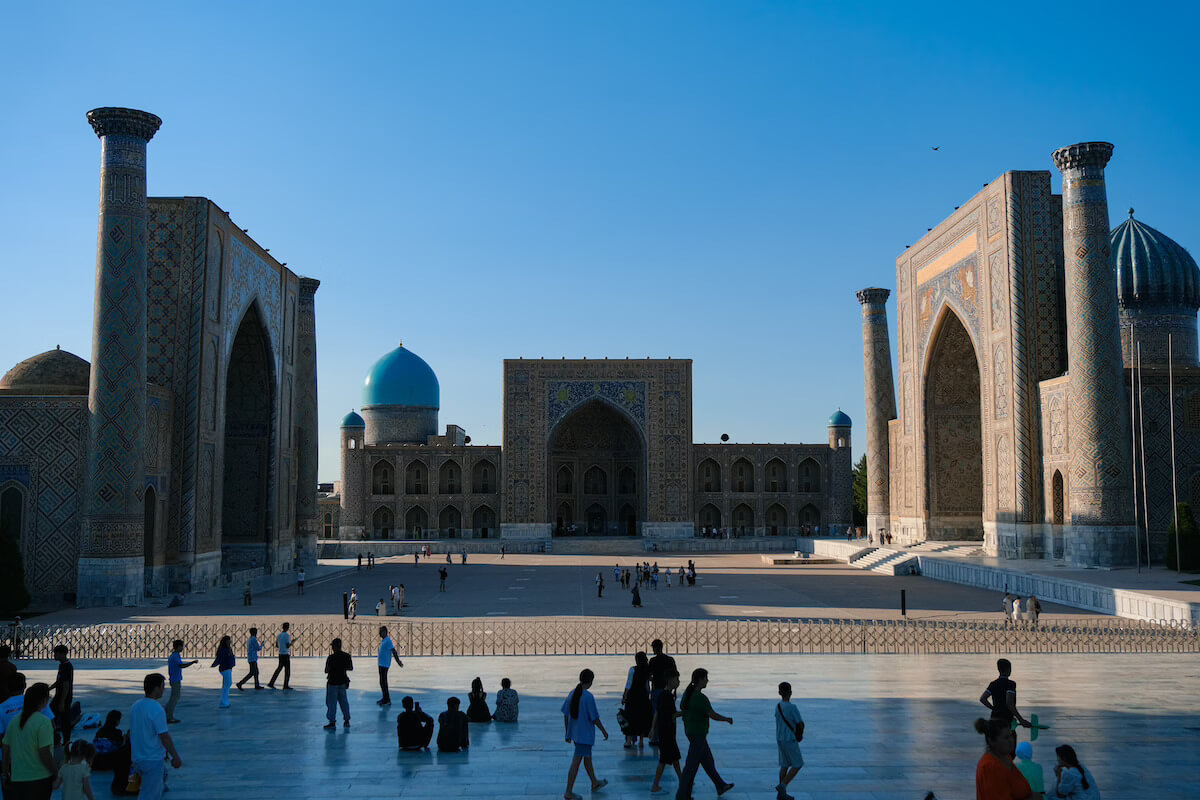
The early train out of Tashkent reaches Samarkand in a little over two hours. You can be standing in front of the Registan — three madrasas the size of cathedrals, tiled in a blue that no camera renders honestly — before the morning heat arrives. Caravans used to spend the better part of a week on that stretch. For most of the last century, it wasn't a journey outsiders made at all.
Uzbekistan spent decades as one of the hardest countries in Asia to enter: letters of invitation, itineraries filed in advance, currency you had to change on the street because the official rate was fiction. Almost none of that is true anymore, and the gap between the country's reputation and its reality is the single best reason to go now.
What Actually Changed
Two things, both recent. The first is paperwork. Since the 2018 reforms, citizens of more than 90 countries — including the US, UK, Canada, Australia, the EU and Schengen states, Japan and South Korea — enter visa-free for 30 days. If your passport isn't on the list, the e-visa at e-visa.gov.uz costs about $20 and takes a few business days. There is no invitation letter, no fixed itinerary, no agency required.
The second is rail. The Afrosiyob, a Spanish-built Talgo running at up to 250 km/h, covers Tashkent to Samarkand in roughly 2 hours 10 minutes and continues to Bukhara. In May 2026 a second high-speed service, the Jaloliddin Manguberdi, started running through to Khiva, replacing the 14-hour overnight haul with a daytime trip of around seven hours. Four cities that used to demand a fortnight now fit comfortably into ten days.
The honest corollary: this is no longer a secret. Samarkand raised entrance fees by roughly 40 percent in early 2026, guesthouses in Bukhara fill in spring, and the fast trains sell out. Uzbekistan is still excellent value. It just rewards the traveler who books ahead rather than the one who wings it.
Samarkand, Bukhara, Khiva: How to Split the Days
Samarkand is the postcard, and it earns it. The Registan, Shah-i-Zinda's corridor of tiled mausoleums, Gur-e-Amir where Timur is buried, the ruins of Ulugh Beg's observatory — this is monumental Islamic architecture at full scale. It's also the most expensive city to sightsee in, and the sites are spread across a big, modern, traffic-heavy city rather than clustered in an old quarter. Give it two full days. Note that the train station sits 10 to 12 kilometres from the centre, so add a taxi at each end when you're comparing the train to a private car.
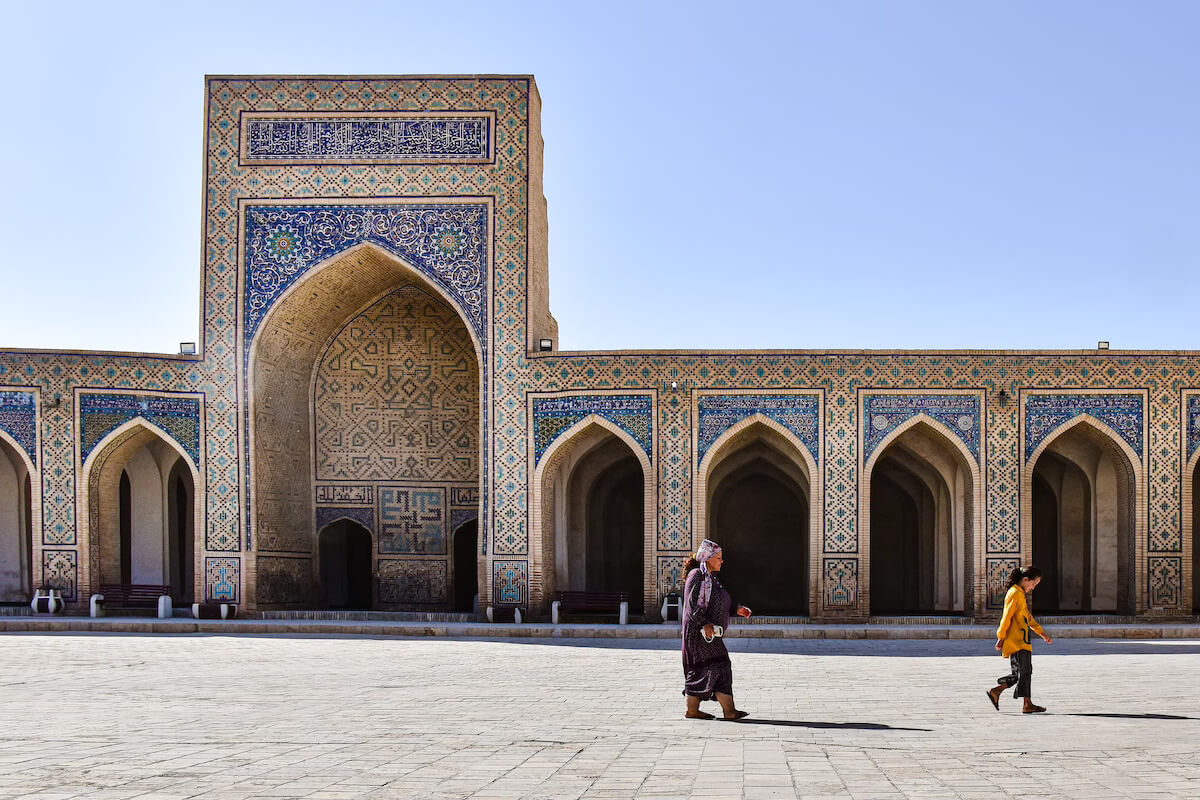
Bukhara is the one most people wish they'd given an extra night. The old town is walkable in a way Samarkand isn't, and much of it — the trading domes, the pools and plane trees of Lyabi-Hauz, the square beneath the Kalon minaret — costs nothing to wander. You pay to enter the Ark fortress and a handful of museums; the rest is simply the city people live in. Come back to the Kalon complex after dark, when the day groups have gone and the square belongs to families out walking.
Khiva is the smallest and the most divisive. The walled inner city, Ichan Qala, is so completely restored that some travelers find it airless — a beautifully maintained exhibit rather than a working town. Stay inside the walls anyway. Between about 6pm and 9am the day-trippers are gone, the mud-brick walls go orange, and you have one of the best-preserved oasis cities on the Silk Road largely to yourself. One night is enough; two if you like quiet.
What It Costs
The som runs at roughly 12,000 to the US dollar as of August 2026, which means every price you see involves large numbers and mental arithmetic. Treat 12,000 as one dollar and 100,000 as about eight, and you'll be close enough.
- Afrosiyob, Tashkent–Samarkand, economy: about 311,000 som (~$26)
- Afrosiyob, Samarkand–Bukhara, economy: about 165,000 som (~$14)
- Registan, Samarkand: 100,000 som (~$8)
- Shah-i-Zinda: 80,000 som; Gur-e-Amir: 75,000 som; Bibi-Khanym: 65,000 som
- Ark fortress, Bukhara: 60,000 som — most of the old town is free
- Ichan Qala combined ticket, Khiva: around 150,000 som (~$12); the lanes themselves are free
- Tashkent metro, any distance: 1,700 som (about 15 cents)
- Guesthouse double in Bukhara or Khiva: $40–70 with breakfast
- Hostel bed: from about $15
- Plov at a neighbourhood canteen: roughly 30,000–50,000 som ($2.50–4)
Budget travelers who stay in guesthouses, eat where locals eat and take the train land around $35–45 a day. Mid-range — boutique courtyard hotels, business class on the fast trains, a guide for a day in Samarkand — runs $75–130. The single biggest lever is accommodation: family-run guesthouses in Bukhara and Khiva, often built around a courtyard with carved wooden columns, routinely beat the chain hotels in Tashkent at half the price.
Plov Is a Dish With a Clock
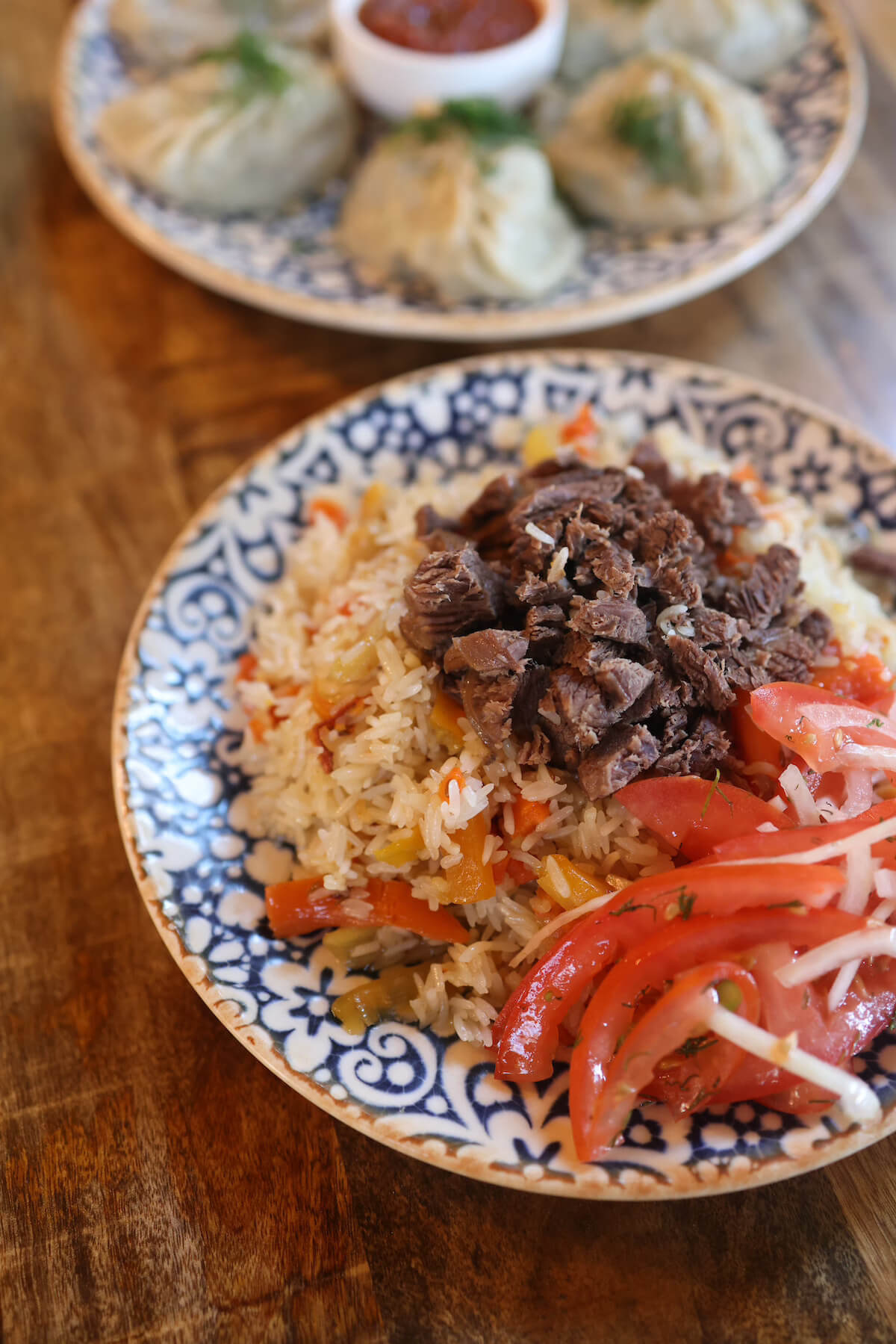
Uzbekistan's national dish is rice slow-cooked with lamb, carrots, cumin and whole heads of garlic in a cast-iron kazan the width of a table. Crucially, it's cooked once, in the morning, and served until it runs out — usually early afternoon. Order plov at eight in the evening and you'll get something reheated. The place to eat it is an osh-xona, a plov canteen, where you'll be waved to a shared table and asked nothing except how much you want.
Around it sits the rest: lagman, hand-pulled noodles in a broth that varies by region; manti, fist-sized steamed dumplings; samsa baked against the wall of a tandoor and handed over too hot to hold; shurpa, a clear mutton soup that appears at breakfast without apology. Bread — non — comes stamped with a pattern and is treated with real seriousness. Tear it, don't cut it, and never set a piece face-down. Green tea arrives with everything, and in summer the melons from Khorezm are worth building a day around.
Getting Around Without a Guide
Yandex Go works in every major city and removes the negotiation from taxis; rides across Tashkent typically cost a couple of dollars. The Tashkent metro is the other thing worth using — Soviet-era stations built as public architecture, with chandeliers, mosaics and cosmonaut motifs, and photography has been permitted since 2018. Between cities, shared taxis leave from the bazaars whenever they fill and cost roughly $20 a seat on the Tashkent–Samarkand run, which makes them a reasonable fallback rather than a first choice. Pick up a local SIM at the airport with your passport; data is cheap and coverage along the main corridor is good.
When to Go
April to early June and September to October are the obvious windows: mild days, cool evenings, everything open. They're also when the trains and the good guesthouses sell out. July and August push past 40°C in the desert cities, which is genuinely punishing between noon and five — but prices soften and the monuments are quiet if you're willing to restructure your day around dawn and dusk. December to February is the cheapest time to come, often bright and clear, cold rather than snowbound, with the sites open and almost empty. If your dates are flexible, aim for Navruz on 21 March, when the spring new year fills courtyards across the country with cooking, music and enormous shared meals.
If You Have More Than Ten Days
West of Khiva, in Nukus, the Savitsky Museum holds thousands of Soviet avant-garde paintings that were banned elsewhere and smuggled into the desert for safekeeping — an unlikely, remarkable collection. Beyond it lies Moynaq, once a fishing port, now a line of rusting ship hulls sitting on sand where the Aral Sea used to be. It is a hard, honest place to visit and not a photo op; go if you want to understand what irrigating a cotton monoculture did to a region, and hire a local driver who can explain what you're looking at.
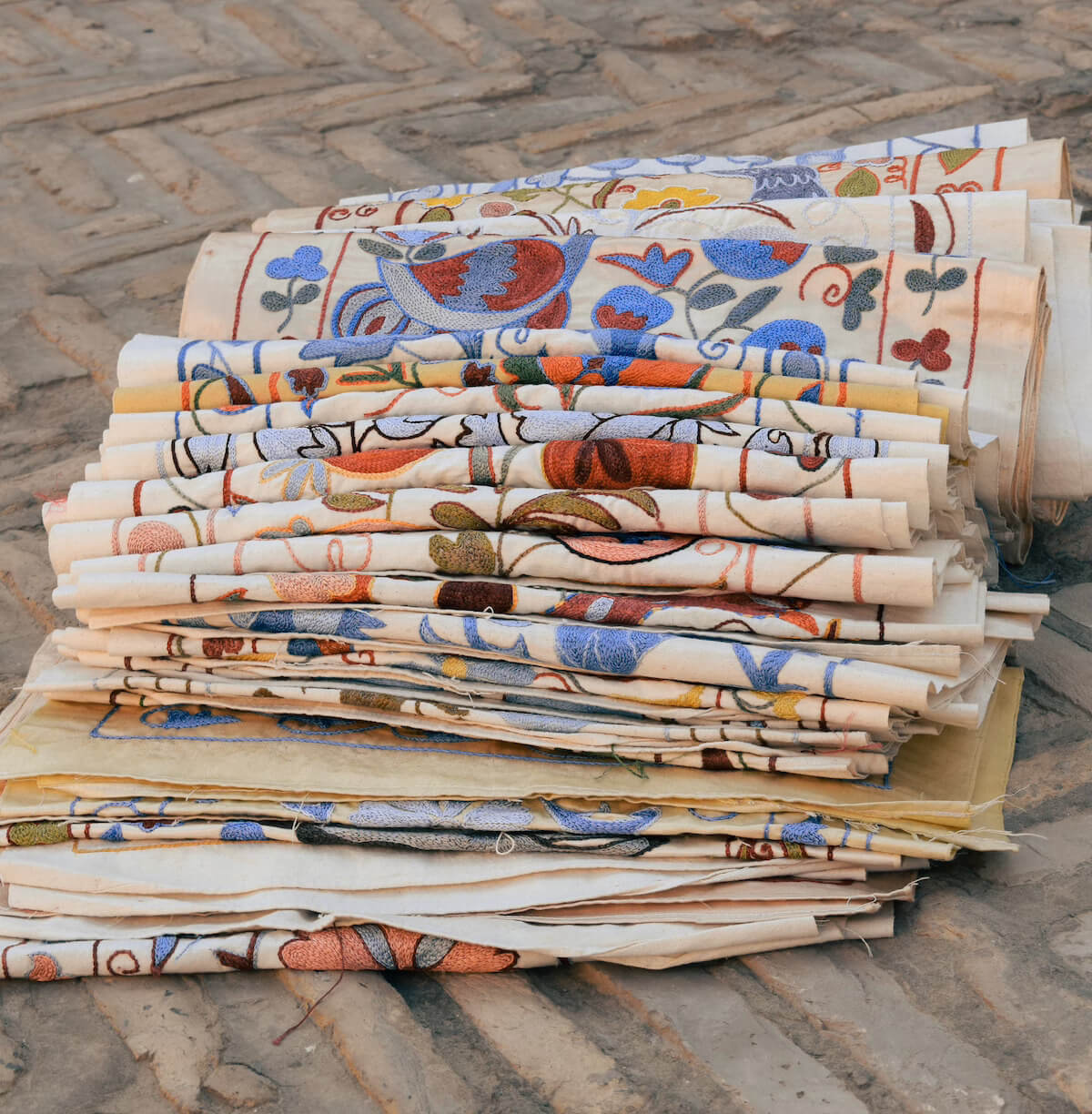
Closer to the main route, the Nurata hills hold yurt camps near Lake Aydarkul where you can sleep on the steppe without pretending you're a nomad. East of Tashkent, the Fergana Valley is where the crafts still live: Rishton for its blue-and-white ceramics, Margilan for silk woven on the old looms. And an hour from the capital, the Chimgan mountains offer proper hiking with almost no foreign visitors on the trails.
A Few Things Worth Knowing
Timur — Tamerlane — is everywhere: on the currency, in the squares, in the museum names. He is the national founding figure, and he was also a conqueror whose campaigns killed on a scale that's difficult to state plainly. Uzbeks are generally happy to discuss both facts. It's a useful reminder that the tilework you came for was commissioned by empires, and that people here hold a complicated history without needing visitors to simplify it for them.
- Carry cash. Cards work in city hotels and larger restaurants; bazaars, canteens, taxis and most ticket windows do not take them.
- ATMs accepting foreign cards are common in the big cities and scarce out west. Withdraw before heading to Nukus or Moynaq.
- Uzbek and Russian are the working languages. English is increasingly common among younger people in tourism, rare outside it — a translation app earns its keep.
- Dress modestly at religious sites: covered shoulders and knees, and a scarf for women entering working mosques.
- Ask before photographing people, especially at markets and in the Fergana Valley. A refusal is not unfriendliness.
- Drink bottled or filtered water. Tap water is chlorinated but not reliably safe for visitors.
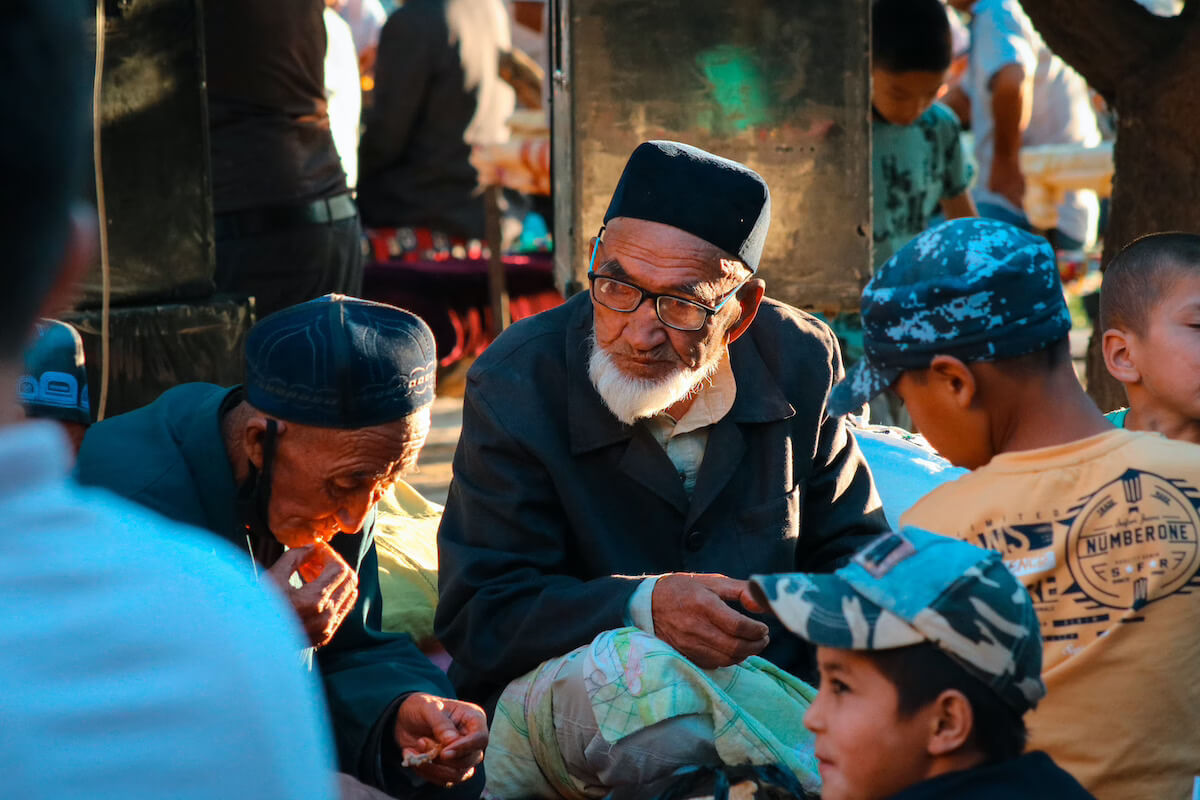
- Hospitality can be insistent. Being invited for tea is normal and usually means exactly that.
The Ten-Day Version
Two nights in Tashkent to adjust and eat, three in Samarkand, three in Bukhara, two in Khiva, flying home from Urgench so you're not backtracking. Book the trains the day the window opens, leave the middle of your afternoons unplanned, and accept that you'll spend one of them sitting in a courtyard drinking tea you didn't order with someone whose name you'll struggle to spell later. That's the country working as intended.
Prices and schedules here were checked in August 2026. Fares and entrance fees in Uzbekistan have moved quickly over the past two years — treat these as a planning baseline and confirm the current numbers when you book.


Comments
How did this story make you feel?
No comments yet. Be the first to share your thoughts!