Nyepi: The One Day a Year Bali Closes Its Airport and Turns Off the Lights
For 24 hours every March, an island of four million people agrees to stop. No flights, no scooters, no lights after dark. Here's what Bali's Day of Silence actually involves, what's enforced, and why you should plan a trip around it rather than away from it.
At six in the morning, Bali stops making noise. Not quiets down. Stops.
The scooters that normally start their two-stroke drone before dawn stay parked. Ngurah Rai International grounds every flight for a full 24 hours—roughly 440 aircraft movements, erased from the schedule months in advance. The ferries at Gilimanuk and Padangbai tie up. Warungs are shuttered, beaches are empty, and the pecalang—village security men in black-and-white checked sarongs—walk the lanes looking for light. If yours is visible from the street after dark, they will knock.
This is Nyepi, and for one day you are not a tourist in Bali. You are a person in a house who has agreed to be quiet. Most travelers treat the date as a hazard to route around. That instinct is backwards. Nyepi and the night before it are the most interesting 48 hours in the Balinese year, and the entry price is a single day of stillness.
A New Year That Runs Backwards
Almost every new year on earth is celebrated with noise. Nyepi inverts the whole idea. It marks the first day of the Saka year, a calendar whose epoch dates to 78 AD and which tracks lunar cycles—which is why the Gregorian date shifts each year. The word itself comes from sepi: silent, empty.
The traditional logic is elegant. The ceremonies in the days beforehand deliberately stir up the island's malevolent forces. Then Bali goes completely dark and completely still, so that anything hostile passing overhead looks down, sees no fires and no movement, concludes the island is abandoned, and moves on. The silence is not passive. It is a strategy.
For Balinese Hindus, the day is governed by four vows known collectively as the Catur Brata Penyepian:
- Amati Geni — no fire, no light, no electricity
- Amati Karya — no work
- Amati Lelungan — no travel, no leaving the family compound
- Amati Lelanguan — no entertainment, no indulgence
Observance varies. Some families fast and meditate for the full 24 hours. Others simply stay home, cook in the dark, and sleep early. Visitors are not expected to take the vows—but the outward half of them, the staying put and the staying dark, applies to everyone on the island.
The Loudest Night of the Year Comes First
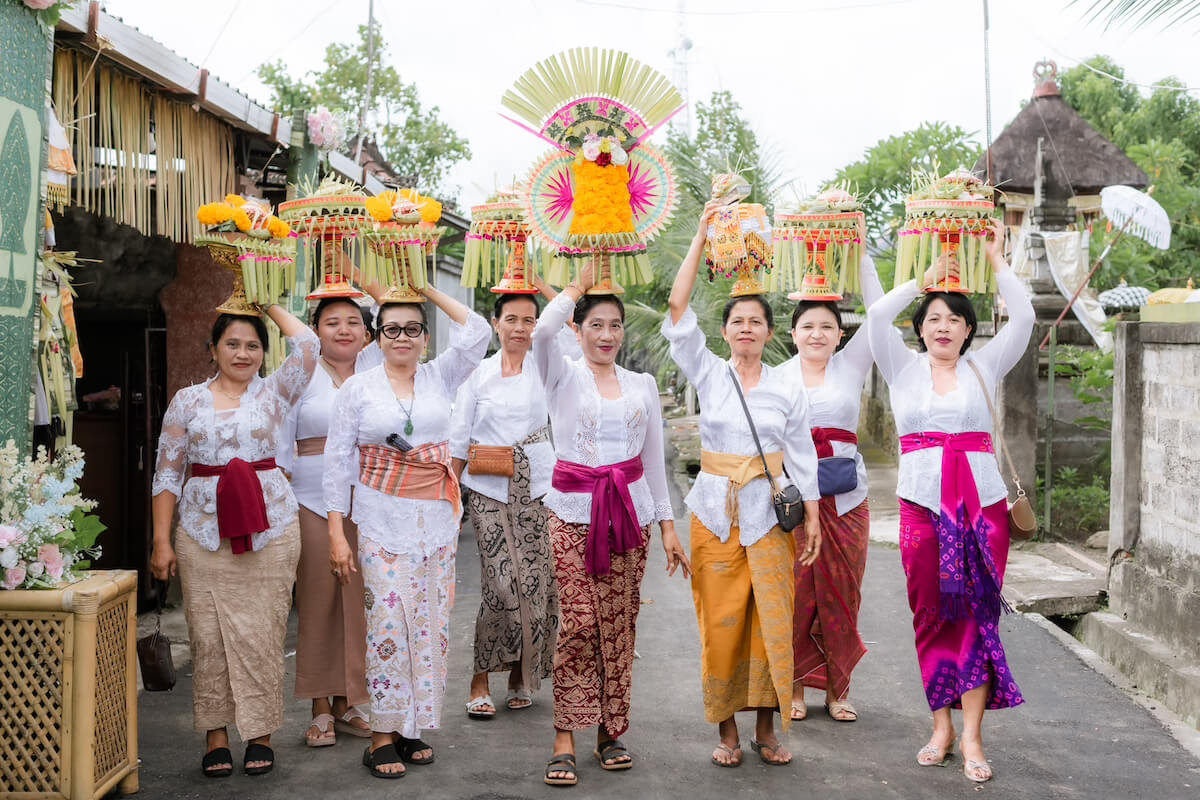
Three to four days before Nyepi comes Melasti, and it is the thing almost no traveler plans for. Entire villages walk their temple's sacred objects—the pratima—down to the sea or to a holy spring to be purified. It is a slow-moving river of white and gold: tiered ceremonial umbrellas, gamelan carried on shoulders, women balancing offerings on their heads, a kilometer of people walking a road that is normally full of rental scooters. Nobody charges admission. Nobody performs it for you. Ask your guesthouse which day their banjar is going and where.
Then comes the eve of Nyepi itself. Offerings are laid at crossroads in the afternoon, and after dark the ogoh-ogoh come out.
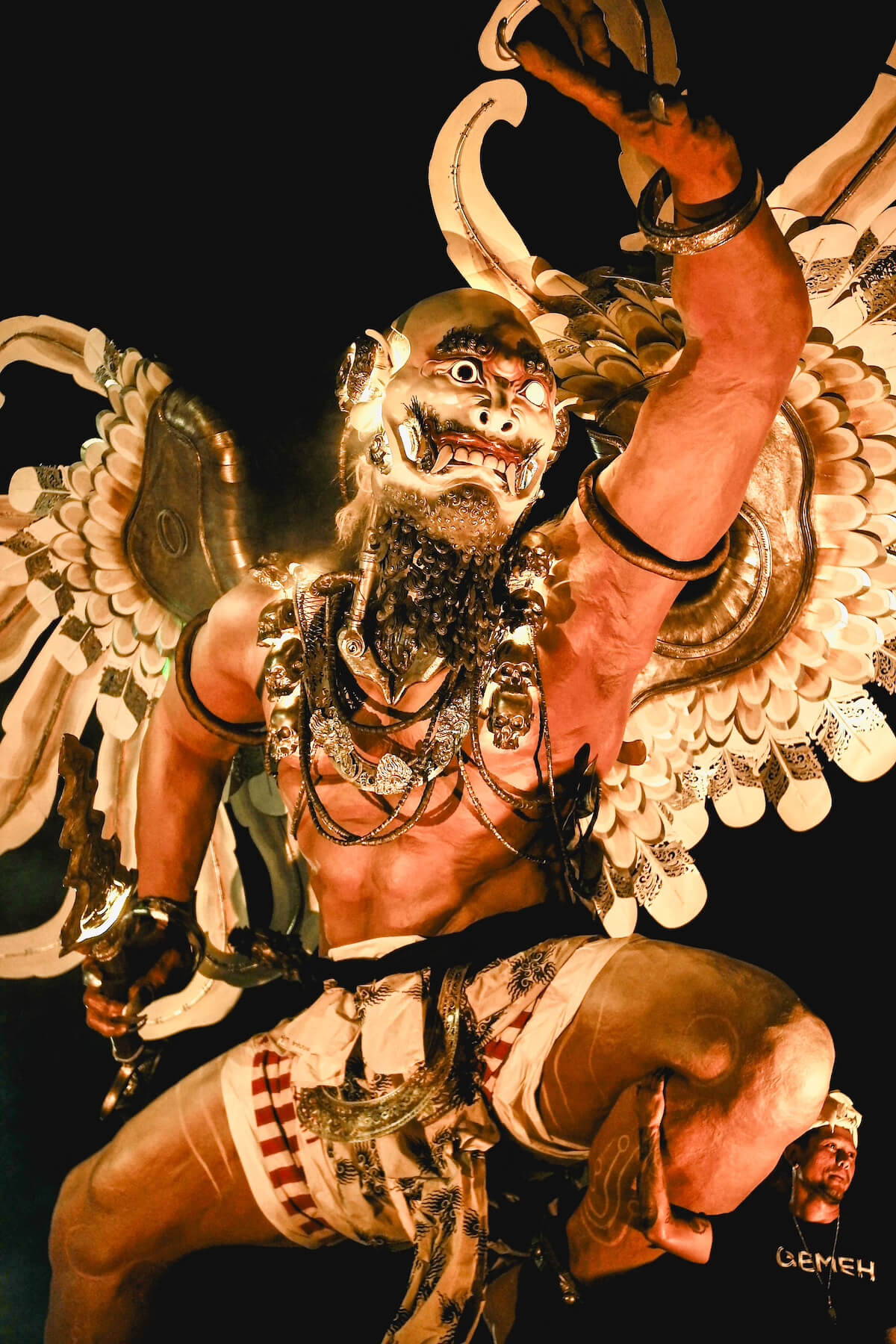
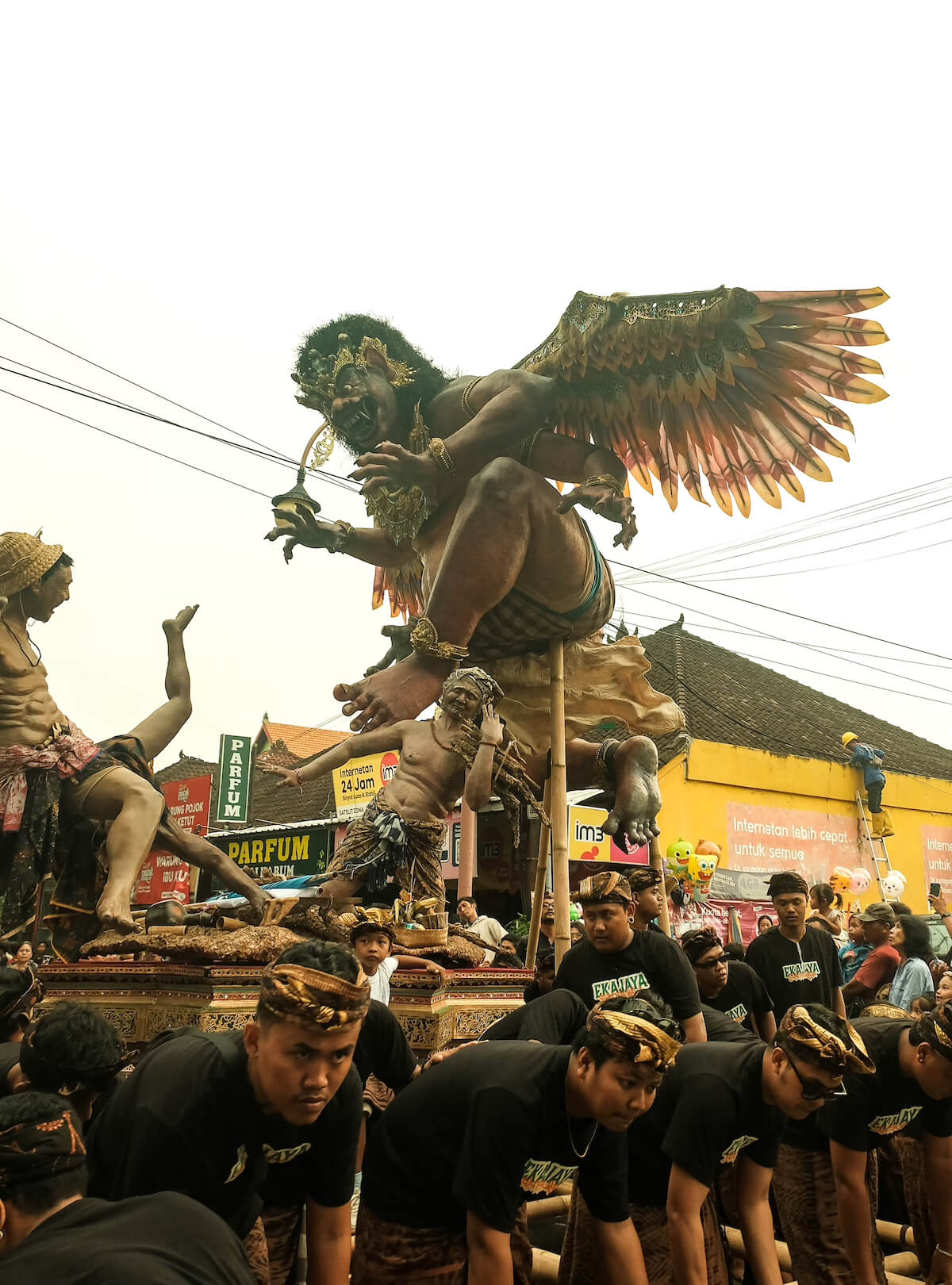
These are the demon effigies—some four meters tall, some considerably taller—built by the sekaa teruna, the youth association of each banjar, or neighborhood. The frame is bamboo and rattan; the skin is papier-mâché, painted and dressed. A single figure takes anywhere from one to five months of evenings, funded by the neighborhood. Styrofoam has been barred from the official contests since 2015 because of what it releases when burned. In Denpasar's 2026 city competition, 223 figures were entered and 16 made the final, with a first prize of 50 million rupiah—around $3,000, which mostly goes back into next year's build.
The processions start around 6 or 7 pm and run toward midnight, accompanied by beleganjur ensembles: drums, cymbals and gongs at a volume designed to be felt in the chest. At each intersection the figure is hoisted and spun three times counterclockwise. Crossroads are where spirits are said to gather, and the spinning is meant to disorient whatever has attached itself to the effigy. Afterward, tradition calls for the ogoh-ogoh to be burned. Contest winners are often spared and stored for exhibition.
What's Actually Enforced (And What Isn't)
Nyepi runs 6 am to 6 am. For visitors, the four vows compress into three practical rules: stay on your property, keep light and sound from leaving it, and stay off the beach. The pecalang enforce this, and they are polite about it right up until they aren't.
The infrastructure shutdown is real and worth understanding before you book. The airport closes at 6 am for the full 24 hours. Sea crossings stop early: in 2026, Gilimanuk suspended service at 5 am, Padangbai at 4 am, and the Java-side port at Ketapang shut the evening before. Mobile data goes off across the island, along with local television and radio broadcasts. Fixed-line WiFi stays on—hospitals, emergency services, police posts, hotels and private homes keep their connections. In practice: your hotel's WiFi will probably work, your SIM card will not.
Inside your accommodation, more is permitted than people expect. You can swim, eat whatever the kitchen has prepared in advance, read, sleep. What you cannot do is be seen or heard from outside. Curtains close at dusk, and most properties run one dim corridor light and nothing else. Medical emergencies are the recognized exception to everything—hospitals stay staffed, and an ambulance moves freely.
What the Day Actually Feels Like
The first thing you notice is not silence, it's the wrong sounds. Roosters, which are always there, suddenly have no competition. A gecko on a wall. Wind in palm fronds, which turns out to be surprisingly loud. Sounds that have been buried under engine noise your entire time on the island surface all at once.
Morning is easy. By early afternoon it gets harder, and this is the part nobody warns you about: there is no errand to run, no walk to take, no scroll to fall into. Around two o'clock most people hit a wall of restlessness. It passes. What's on the other side of it is the reason to do this.
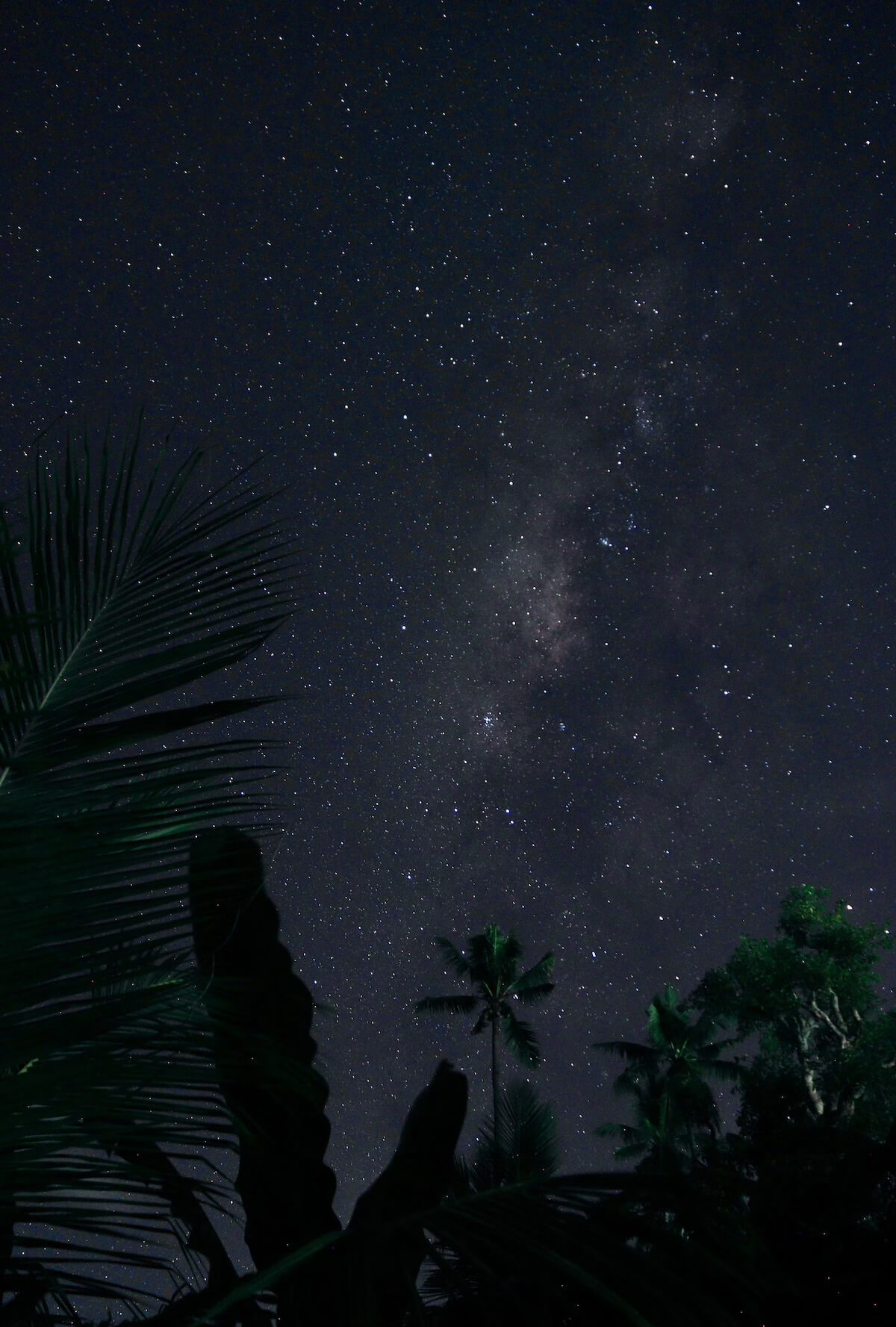
Then dusk, and then the sky. Bali holds well over four million people and normally throws enough light to wash the stars out entirely. On Nyepi night the Milky Way is visible from places where you would not believe it. If you have any choice in where you spend the day, choose somewhere with an unobstructed view up.
The effect is measurable, not just poetic. Researchers examining Nyepi 2022 found island PM2.5 concentrations fell roughly 47 percent against the 2020–2022 average, with the deepest drop overnight. One day a year, Bali gets to find out what its own air tastes like.
Planning Around It
Nyepi 2027 falls on Tuesday 9 March, with the ogoh-ogoh parades on the evening of the 8th. In 2028 it lands on Sunday 26 March. Because the date follows the Balinese Saka calendar rather than the Gregorian one, always confirm against a current source before you commit to flights.
The single most important booking rule: reserve at least three consecutive nights at one property, covering the parade night, Nyepi itself, and the morning after. Do not plan to arrive, depart, or switch accommodation on Nyepi—none of it is possible. If your flight out lands on the wrong side of the closure, you will simply be staying an extra night.
Where you spend it matters more than usual, because you're spending 24 hours there. Ubud and the Sidemen valley give you the highest density of ceremony in the surrounding days and dark, quiet nights. A place with a pool, a balcony, or a garden is worth paying up for. A windowless budget room in Kuta is a genuinely long day. Nyepi doesn't drive a price spike the way Christmas does—many properties simply run a set-menu package for the day—but rooms in the good spots go early. (Pricing as of mid-2026; check current rates.)
- Snacks and drinking water beyond whatever the property provides
- Any medication you need, with a 48-hour buffer
- Cash — ATMs may be unstocked and shops are shut the day before by early afternoon
- Books and films downloaded in advance, since mobile data goes dark
- A charged power bank
- Mosquito repellent, if you plan to sit outside after sunset
Ngembak Geni: The Island Exhales
At six the next morning it all restarts, and the contrast is genuinely disorienting. The day is called Ngembak Geni—roughly, relighting the fire. Families visit each other and ask forgiveness for the year behind them.
In one neighborhood it gets considerably less serene. At Banjar Kaja in Sesetan, Denpasar, unmarried locals aged 17 to 30 line up on the main street in two groups, men on one side and women on the other, and on a signal from a priest they surge toward each other, pulling and embracing while the pecalang throw buckets of water over the whole scrum to break it up. This is Omed-omedan, roughly "pull-pull." The origin story involves a village head who fell ill from the noise of the game, ordered it stopped, and recovered the moment he stepped outside to do so—so it has been held every year since. It's crowded, public, and entirely open to watch.
Is It Worth Building a Trip Around?
Be honest with yourself about the arithmetic. If you have seven days in Bali and one of them is Nyepi, you're giving up a meaningful slice of your time. On a two-week trip it costs you almost nothing, and you get the ogoh-ogoh night, the Melasti processions, the silence, and a sky you can't see any other night of the year.
What makes Nyepi different from most things sold as cultural experiences is that it isn't sold at all. Nobody performs it for visitors, no ticket exists, and the island would do exactly this whether or not you were watching. You are not an audience. For 24 hours you're just another person on a quiet island, doing the same thing everyone else is doing.
Check the Saka calendar before you book. Then book the week that contains it.


Comments
How did this story make you feel?
No comments yet. Be the first to share your thoughts!